

AL-E066 UJT FIRING OF SCR TECHNIQUE
Project Information
- Category: ELECTRICAL ENGINEERING
- Sub Category: POWER ELECTRONICS AND DRIVE LAB
- Model Number: AL-E066
Description
AL-E066 UJT
FIRING OF SCR TECHNIQUE TRAINER
UJT Firing of SCR Technique Trainer
Product Category: Power Electronics Laboratory
Equipment
AL-E066
1. Product
Description
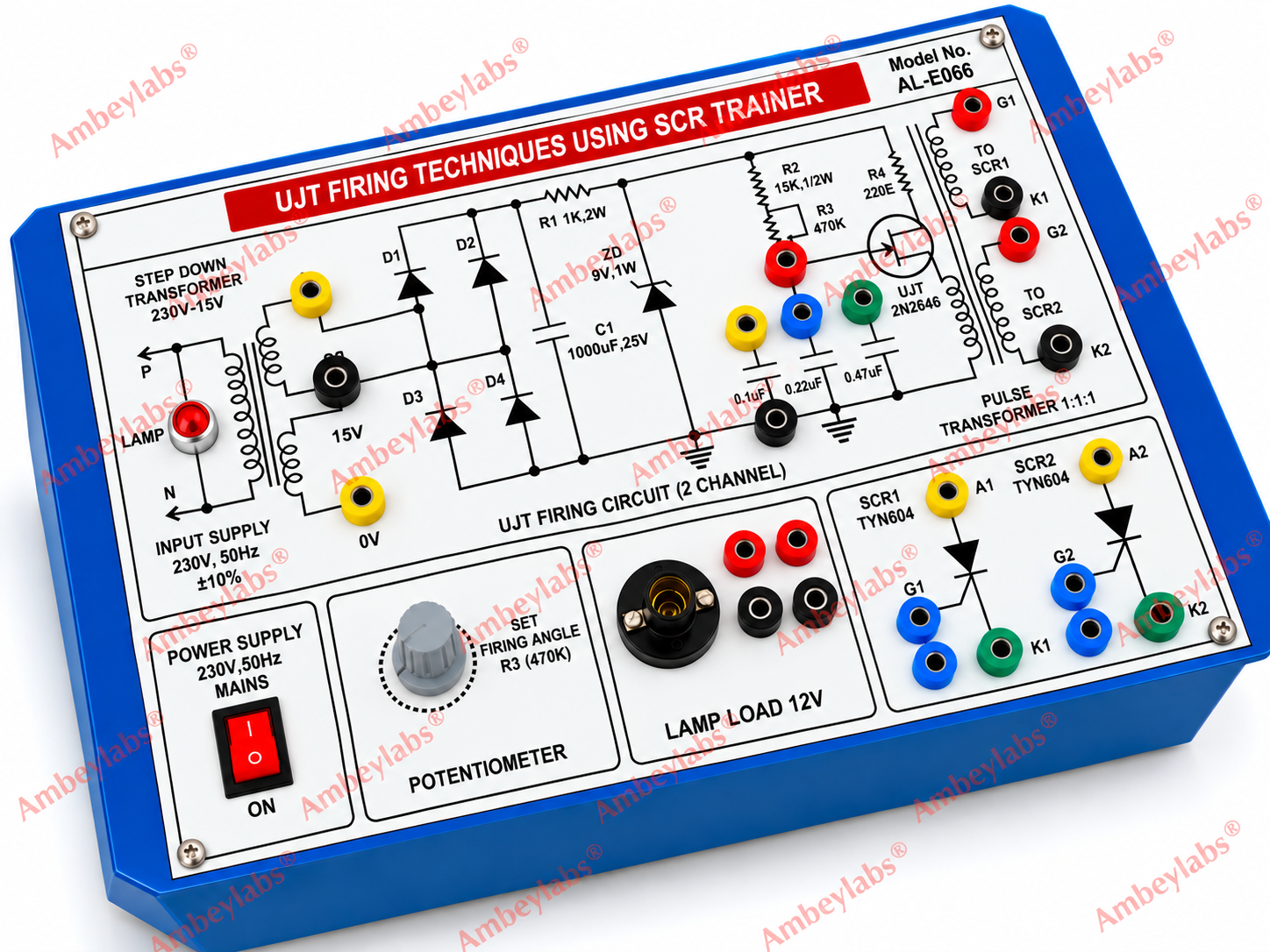
The AL-E066 UJT Firing of SCR Technique Trainer is
designed for practical study of Unijunction Transistor (UJT) firing circuits
and Silicon Controlled Rectifier (SCR) triggering techniques. It enables
students to investigate controlled rectification, half-wave controlled
converters, fully controlled single-phase converters and single-phase AC
voltage regulation.
The trainer incorporates isolated AC power
supplies, a UJT firing circuit, SCR assemblies, a pulse transformer, a
potentiometer for firing-angle control and a resistive lamp load. Components
are mounted on a printed front panel with circuit diagrams and 2 mm connection
sockets.
2. Detailed
Technical Specifications
|
S. No. |
Parameter |
Technical specification |
|
1 |
Product name |
UJT Firing of SCR Technique Trainer |
|
2 |
Model number |
AL-E066 |
|
3 |
Laboratory |
Power Electronics Lab |
|
4 |
Mains supply |
230 V AC, 50 Hz, +10% as stated in the source |
|
5 |
Isolated AC power supply 1 |
0–12 V AC, 500 mA |
|
6 |
Isolated AC power supply 2 |
0–12 V AC, 250 mA |
|
7 |
SCR assembly |
TYN604 SCR assembly, 2-bit as stated |
|
8 |
Resistive load |
12 V lamp |
|
9 |
UniJunction transistor |
2N2646 |
|
10 |
Pulse transformer |
1:1:1 turns ratio |
|
11 |
Firing-angle control |
Potentiometer-based adjustment |
|
12 |
Additional components |
Diodes, capacitors and resistors |
|
13 |
Front panel |
Insulated printed circuit board sheet with
printed circuit diagrams and symbols |
|
14 |
Connection system |
2 mm patch cords |
|
15 |
Test points |
2 mm sockets for high-voltage test points, as
stated in the source |
|
16 |
Short-circuit protection |
Fuse |
|
17 |
Cabinet |
ABS plastic cabinet |
|
18 |
Approximate dimensions |
12 × 8 inches |
|
19 |
Instruction manual |
Included |
|
20 |
Optional accessory |
CRO (cathode-ray oscilloscope) |
|
21 |
Manufacturer |
Ambey International |
3. Scope of
Learning and Experiments
The trainer supports the following experiments, as
specified in the source document:
- Study of the UJT firing circuit.
- Testing of a single-phase fully controlled
converter using UJT firing.
- Testing of a single-phase half-wave controlled
converter.
- Testing of a single-phase AC regulator.
4.
Functional Modules
4.1 UJT
Firing Circuit
·
UJT type:
2N2646.
·
Resistor
and capacitor network for firing-pulse generation.
·
Potentiometer
control for adjusting the firing angle.
·
Pulse
transformer with 1:1:1 turns ratio for pulse coupling.
4.2 SCR
Converter Module
·
TYN604 SCR
assembly.
·
Connection
facilities for SCR triggering and converter experiments.
·
Supports
investigation of controlled rectification and firing-angle variation.
4.3 Power
Supply Module
·
Isolated
0–12 V AC, 500 mA output.
·
Isolated
0–12 V AC, 250 mA output.
·
Mains
input: 230 V AC, 50 Hz, as specified.
4.4
Resistive Load Module
·
Built-in
12 V lamp load.
·
Provides a
visual indication of load operation during experiments.
4.5
Connection and Measurement Facilities
·
Printed
circuit diagrams and component symbols.
·
2 mm
connection sockets and patch cords.
·
Optional
cathode-ray oscilloscope for observing waveforms, when supplied separately.
5.
Construction and Safety Features
·
Compact
ABS plastic enclosure.
·
Insulated
front panel with printed circuit layouts.
·
Fuse-based
short-circuit protection.
·
Clearly
identified components and connection points.
·
Isolated
low-voltage AC supplies for the specified experimental circuits.
·
2 mm patch
cords for circuit interconnections.
Safety note: The source refers to high-voltage test
points. The actual socket ratings and protection arrangements should be
confirmed before use. Mains-powered experiments should be conducted by trained
personnel under appropriate laboratory supervision.
6. Applications
·
Electrical
and electronics engineering laboratories.
·
Power
electronics practical training.
·
Polytechnic
and engineering college laboratories.
·
SCR
triggering and controlled rectifier demonstrations.
·
Study of
AC voltage controllers and phase-angle control
OPTIONAL ACCESSORIES:
·
CRO