

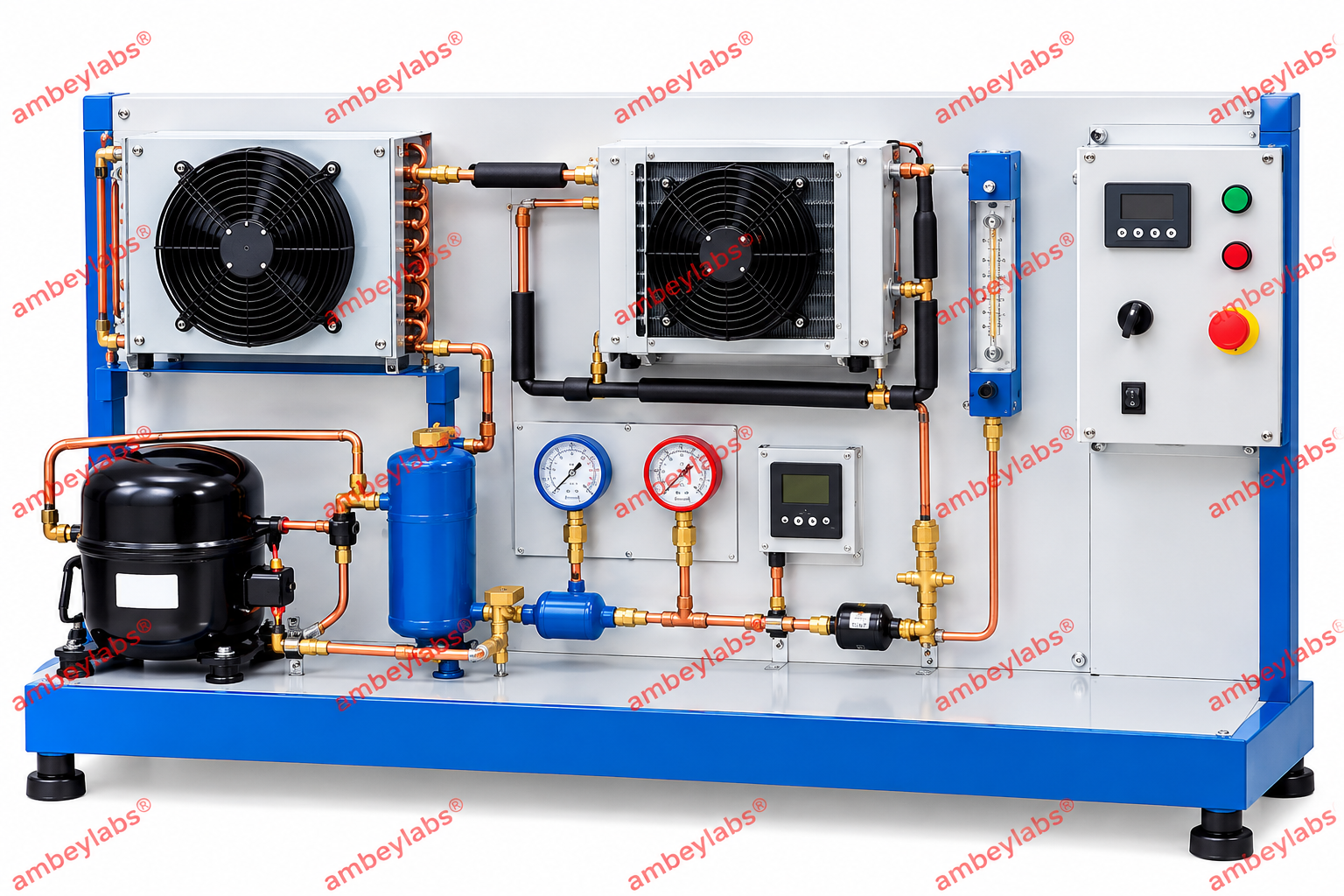
AL-E1167 REFRIGERATION, HEATING & AIR CONDITIONING (HVAC) EXPERIMENTAL PLANT
Project Information
- Category: MECHANICAL ENGINEERING
- Sub Category: RAC LAB
- Model Number: AL-E1167
Description
AL-E1167
REFRIGERATION, HEATING & AIR CONDITIONING (HVAC) EXPERIMENTAL PLANT
Product Overview
The AL-E1167 Refrigeration, Heating and Air
Conditioning (HVAC) Experimental Plant is a compact bench-top training system
designed for practical study and demonstration of refrigeration, heating, cooling, freezing and
air-conditioning principles.
The system incorporates fan evaporators,
dedicated cooling and freezing stages, a coaxial heat exchanger, refrigerant
and glycol-water flow measurement, and comprehensive temperature and pressure
instrumentation. The clearly visible process components enable students to
understand refrigeration-cycle operation, heat transfer and system performance
through practical experimentation.
Key Training Areas
- Fundamentals of refrigeration
and cooling cycles
- Cooling-stage
operation
- Freezing-stage
operation
- Heat transfer through
a coaxial heat exchanger
- Temperature measurement
- Refrigeration pressure
measurement
- Refrigerant flow
measurement
- Glycol-water mixture
flow measurement
- Heating and cooling
performance evaluation
- Comparison of cooling
and freezing stages
- Practical HVAC system operation and analysis
Technical Specifications
|
S. No. |
Section |
Parameter |
Specification |
|
1 |
Fan Evaporator – Cooling Stage |
Heat Transfer Surface Area |
1.21 m² |
|
2 |
Air Flow Rate |
80 m³/h |
|
|
3 |
Cooling Capacity |
140 W at tL1 = 5°C, ΔT1 = 10 K |
|
|
4 |
Fan Evaporator – Freezing Stage |
Heat Transfer Surface Area |
3.62 m² |
|
5 |
Air Flow Rate |
125 m³/h |
|
|
6 |
Freezing Capacity |
330 W at tL1 = 5°C, ΔT1 = 10 K |
|
|
7 |
Coaxial Heat Exchanger |
Capacity |
1.6 kW at 0°C |
|
8 |
Temperature Difference |
ΔT = 9 K |
|
|
9 |
Temperature Measurement |
Measuring Range |
11 × −50 to +150°C |
|
10 |
Pressure Measurement |
Measuring Range |
2 × −1 to 15 bar; 1 × −1 to 24 bar |
|
11 |
Refrigerant Flow Measurement |
Measuring Range |
1 × 4 to 40 l/h |
|
12 |
Glycol-Water Flow Measurement |
Measuring Range |
1 × 2.5 to 65 g/s |
|
13 |
Electrical Power |
Measurement Range |
0–1150 W |
|
14 |
Construction |
Configuration |
Compact bench-top experimental plant |
Fan Evaporator – Cooling
Stage
The
cooling section shall incorporate a fan evaporator with:
- Heat-transfer
surface area: 1.21
m²
- Airflow rate: 80 m³/h
- Cooling capacity: 140 W
- Reference condition:
tL1 = 5°C, ΔT1 = 10 K
This section enables students to investigate the operation and performance of a refrigeration cooling stage.
Fan Evaporator – Freezing
Stage
The
freezing section shall incorporate a larger fan evaporator with:
- Heat-transfer surface
area: 3.62 m²
- Airflow rate: 125 m³/h
- Freezing capacity: 330 W
- Reference condition:
tL1 = 5°C, ΔT1 = 10 K
The separate cooling and freezing stages allow comparative study of refrigeration performance under different operating conditions.
Coaxial Heat Exchanger
The
experimental plant shall include a coaxial heat exchanger for practical
heat-transfer studies.
|
Parameter |
Specification |
|
Capacity |
1.6 kW at 0°C |
|
Temperature Difference |
9 K |
Measurement & Instrumentation
Temperature
- 11 temperature measurement
channels
- Measuring range: −50 to +150°C
Pressure
Pressure
measurement shall include:
- 2 channels: −1 to
15 bar
- 1 channel: −1 to
24 bar
Refrigerant Flow
- Measuring range: 4–40 l/h
- Quantity: 1 flow measurement channel
Glycol-Water Flow
- Measuring range: 2.5–65 g/s
- Quantity: 1 flow measurement channel
Electrical Power
- Measurement range: 0–1150 W
Features & Benefits
- Compact bench-top construction
suitable for teaching and training laboratories.
- Clearly visible
refrigeration and HVAC components.
- Dedicated cooling
and freezing sections for comparative experiments.
- Integrated coaxial
heat exchanger for heat-transfer studies.
- Temperature and
pressure measurement at multiple process points.
- Refrigerant flow
measurement.
- Glycol-water mixture
flow measurement.
- Electrical power
monitoring.
- Suitable for
practical HVAC system-performance evaluation.
- Appropriate for engineering education, vocational training and technical laboratory applications.
Suggested Experiments
The
AL-E1167 can be used for practical experiments such as:
- Study of basic
refrigeration-cycle operation.
- Study of the cooling
stage.
- Study of the freezing
stage.
- Comparison of
cooling and freezing performance.
- Determination of
cooling capacity.
- Determination of
freezing capacity.
- Study of heat
transfer through a coaxial heat exchanger.
- Measurement of
refrigerant flow rate.
- Measurement of
glycol-water flow rate.
- Measurement of
refrigeration-system pressures.
- Measurement of
temperature at different process points.
- Study of the effect
of airflow on evaporator performance.
- Electrical power measurement
of the experimental plant.
- Analysis of HVAC
system operating parameters.
- Comparative evaluation of refrigeration and heat-transfer performance